
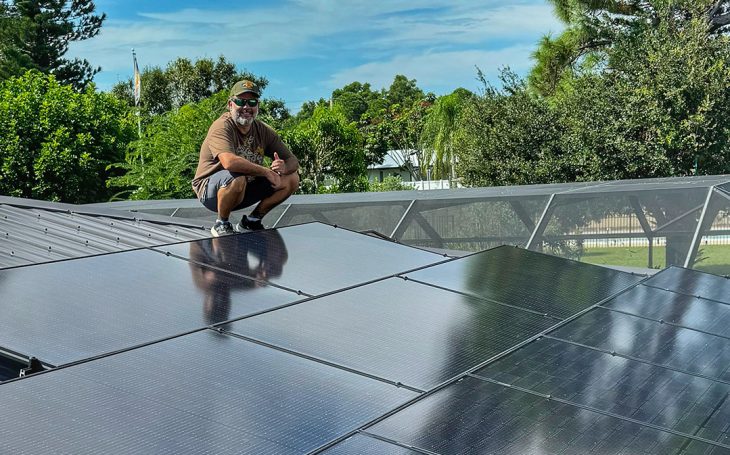
Last updated: May 2026 | Written by the engineering team at Ecuip LLC, signed and sealed solar engineering for DIY homeowners across Florida, Texas, California, and Georgia.
Quick Take: The DIY Solar Math Just Changed
If you are actively planning a DIY solar system in Florida in 2026, the rules of the game shifted overnight on January 1, 2026, when the 30% federal residential solar tax credit (Section 25D) expired for customer-owned systems. That single change added thousands of dollars to every quoted installer price — and made the decision to install your own solar panels one of the only remaining ways to build a properly engineered DIY home solar system at a price that still makes financial sense.
This guide is written for the homeowner who is past the “is solar worth it” stage. You have a roof, you have a utility bill, and you are seriously considering installing solar panels yourself. You want to know exactly how DIY solar installation works in Florida, what DIY solar kits and equipment actually pass permitting, how to size a system correctly, what your county requires, how net metering works post-ITC, and where homeowners blow up their own projects.
We will not waste your time. Let’s get into it.
Free DIY solar calculator: Try Heliosketch first
Before you read this entire guide (it is long, and worth it), spend 10 minutes in Heliosketch — our free DIY solar planning tool. Sketch your roof, place panels on it, estimate the battery size you’d need, and get a head start on your design. It will make every section of this guide land harder once you have a concrete starting point for your own DIY solar power system. Open Heliosketch free →
Table of Contents
- Can you legally install your own solar panels in Florida?
- Why DIY solar matters more in 2026 than it did in 2025
- How much money you can actually save
- The 9-step DIY solar roadmap
- System sizing for Florida homes (with real math)
- Equipment selection that actually passes permitting
- Florida-specific engineering considerations
- Permitting county-by-county
- Net metering and utility interconnection
- Battery backup: when it actually makes sense
- Mistakes that kill DIY projects
- When you should NOT DIY
- Choosing an engineering partner
- Frequently asked questions
1. Can You Legally Install Your Own Solar Panels in Florida?
Yes — you can absolutely install your own solar panels in Florida. The state explicitly allows homeowners to act as their own contractor on their primary residence under what is known as an owner-builder permit. This is the legal foundation that makes self-install solar possible in the state, and it is codified in Florida Statute 489.103(7).
The owner-builder exemption lets you pull your own permits for work on a home you own and occupy. You sign a disclosure statement at the building department acknowledging that you understand you are acting as the contractor, that you cannot sell or rent the property within one year of completion, and that you are personally responsible for the workmanship.
What the exemption does not do is wave away the rest of the building code. You still need:
- A signed and sealed engineering plan set from a Florida-licensed Professional Engineer
- Approved equipment that meets Florida Product Approval or Miami-Dade NOA requirements where applicable
- A passing inspection at every required milestone
- A separate utility interconnection agreement with your power company
- In most cases, a licensed master electrician to handle the final tie-in to your main service panel — though this varies by county
That last point is the one that trips up the most homeowners. Some Florida AHJs (Authorities Having Jurisdiction) allow the owner-builder to perform 100% of the electrical work themselves. Others require a licensed electrician to make the connection at the main panel or to perform a “service drop” if the system requires a panel upgrade. Miami-Dade and Broward tend to be stricter; rural counties in the panhandle and central Florida tend to be more permissive.
The takeaway: DIY solar is legal in Florida, but you cannot self-engineer or self-inspect. You can almost always install solar yourself on the physical side, and you can usually DIY the conduit and DC-side work. The AC tie-in is where local rules vary the most.
2. Why DIY Solar Matters More in 2026 Than It Did in 2025
Three things converged in 2025 and 2026 to make this the strongest case for DIY solar installation in a decade. If you’ve been on the fence about DIY home solar, the financial argument got dramatically louder this year.
The federal solar tax credit expired
The One Big Beautiful Bill Act, signed into law in July 2025, terminated the Section 25D Residential Clean Energy Credit for systems placed in service after December 31, 2025. The residential solar tax credit, which allowed homeowners to claim 30% of their solar system costs as a tax credit, expired for customer-owned systems in 2026. Third-party-owned systems (leases and PPAs) can still claim a different credit through 2027, but for any homeowner who wants to actually own the system, the federal incentive is gone.
This is enormous. A $40,000 installer-quoted system used to net out to roughly $28,000 after the credit. In 2026, that same $40,000 quote stays $40,000. Every dollar of installer markup, dealer fee, sales commission, and financing surcharge now hits the homeowner’s pocket directly. There is no longer a federal rebate cushioning the inflated retail pricing.
DIY solar bypasses most of that markup entirely. Every dollar you save by choosing to install your own solar panels is a dollar of net ROI now that the federal credit no longer cushions the math for either path. The relative advantage of DIY solar panels for home installation has effectively grown by 30%.
Florida electricity rates keep climbing
FPL’s effective all-in residential rate is approximately $0.137/kWh as of January 2026. Duke Energy Florida sits in the $0.13–$0.14/kWh range. Both utilities have filed for additional rate increases tied to grid hardening, hurricane recovery, and natural gas fuel costs. Every penny these rates climb makes a self-installed solar array more valuable, because you are offsetting more expensive grid electricity. The economics of solar do it yourself improve with every rate hike approved by the Florida Public Service Commission.
Florida net metering is still intact — but vulnerable
Florida investor-owned utilities still credit residential solar exports at the full retail rate under net metering rules administered by the Florida Public Service Commission (Rule 25-6.065). Under current Florida net metering rules, investor-owned utilities like FPL and Duke Energy credit solar customers at the full retail electricity rate for excess energy sent to the grid. This is the most favorable net metering structure for homeowners.
But this is the most politically contested incentive in the state. Florida’s legislature has tried to gut net metering more than once. OUC (Orlando Utilities Commission) changed its solar export policy effective July 1, 2025 — new customers now receive a community solar rate of roughly 4.6 cents per kWh for exports instead of full retail. If you are an OUC customer or you live anywhere this kind of rule change is being considered, the time-value of locking in your interconnection agreement matters. Existing customers under net metering are typically grandfathered when policy changes, which is a powerful reason not to delay.
Installer quality has gotten more uneven, not less
Several large national solar installers have filed for bankruptcy in the last 18 months, leaving warranty holders stranded. Sales-driven installation models have produced widespread underperformance complaints. Homeowners are increasingly uncomfortable handing $40,000–$80,000 to a company that may not be in business in five years. The decision to install own solar panels — and own the relationship with manufacturers directly — puts you in direct contact with Sol-Ark, EG4, Enphase, Tesla, Q CELLS, REC, and others who back their own warranties regardless of who installed the system. Do-it-yourself solar isn’t just a cost play anymore; it’s a warranty resilience play.
3. How Much Money Can You Actually Save With DIY Solar in Florida?
Let’s get specific. The average cost of residential solar in Florida is roughly $2.19 per watt before incentives. That is the installer all-in number — equipment, labor, permitting, sales, financing markup, and overhead bundled together. With the 25D credit gone, this is also the net cost.
A typical Florida homeowner installs an 8–12 kW system. At $2.19/W, that’s:
| System Size | Installer Quote (2026) |
|---|---|
| 8 kW | $17,520 |
| 10 kW | $21,900 |
| 12 kW | $26,280 |
| 15 kW (with light battery prep) | $32,850+ |
| Whole-home backup (15 kW + 30 kWh battery) | $55,000–$75,000+ |
Now let’s look at the same DIY home solar systems built with current equipment pricing, no dealer fees, and proper engineering. Whether you source equipment as à la carte components or as DIY solar kits from reputable distributors, these are realistic 2026 numbers based on what we see across hundreds of plan sets per year for homeowners choosing to self install solar panels:
| System Size | DIY Equipment | Engineering & Permits | Inspections / Misc | Total | Savings vs Installer |
|---|---|---|---|---|---|
| 8 kW | $7,200–$8,800 | $400–$800 | $400–$700 | $8,000–$10,300 | $7,200–$9,500 |
| 10 kW | $8,500–$10,500 | $400–$800 | $400–$700 | $9,300–$12,000 | $9,900–$12,600 |
| 12 kW | $10,200–$12,500 | $500–$900 | $500–$800 | $11,200–$14,200 | $12,000–$15,000 |
| 15 kW battery-ready | $12,500–$15,000 | $600–$1,200 | $600–$1,000 | $13,700–$17,200 | $15,000–$19,000 |
| 15 kW + 30 kWh battery | $25,000–$32,000 | $1,000–$1,800 | $1,000–$1,500 | $27,000–$35,300 | $25,000–$40,000+ |
These numbers assume you supply the labor. If you pay an electrician for the final AC tie-in (a few hundred dollars to maybe $2,000 depending on complexity), it shaves a few thousand off the savings column but the math still works decisively in favor of DIY.
What people forget to budget for:
- Florida Product Approval / Miami-Dade NOA documentation (usually free, but takes hours)
- Conduit, fittings, wire, lugs, junction boxes (often $300–$800)
- Mounting hardware beyond the rails (flashings, attachments, end caps — easily $400–$1,000)
- Permit fees ($200–$600 depending on county)
- Bidirectional meter swap (usually no cost, but takes weeks)
- An “extras” buffer of $500–$1,500 for whatever you didn’t anticipate
Even with full margin baked in, the decision to build your own solar system routinely saves homeowners $10,000–$20,000 on a typical solar-only project and $25,000–$40,000+ on a battery-backed system. That savings used to be partially eroded by losing the 30% ITC on labor and engineering you self-performed. As of 2026, the ITC is gone for everyone, so the playing field is level — and the dollar amount you save by choosing to install your own solar is simply the dollar amount you save.
4. The DIY Solar Process: A 9-Step Roadmap
Most homeowners over-complicate the process of building their own solar system. The actual workflow for a DIY solar power system is predictable and sequential. From sizing your DIY solar panels to passing final inspection, here is the order of operations for a successful DIY solar panel installation.
Step 1: Pull a full year of utility data
Log into your FPL, Duke, TECO, or municipal utility account and download 12 months of hourly or monthly consumption data. You need annual kWh, peak month kWh, and ideally time-of-use patterns. This is the foundation for every decision that follows.
Step 2: Define your goals before you size
Are you offsetting 100% of your bill, or 80%? Are you preparing for an EV in the next two years? Do you want partial-home backup during hurricanes, or are you fine going without power for three days? Goals drive design. Skipping this step is how homeowners end up with an undersized inverter or an overpaneled array.
This is also the right moment to open Heliosketch, our free DIY solar calculator. Sketch your actual roof, drop panels onto it, see how many you can realistically fit at the orientation and tilt you have, and get a preliminary battery sizing estimate. You will walk into Step 3 with concrete numbers instead of guesses.
Step 3: Pick your equipment architecture
There are really only three meaningful choices:
- String inverter with optimizers or microinverters, grid-tied only — cheapest, simplest, no backup
- Hybrid inverter, battery-ready but installed without battery — more flexible, future-proof, slightly more expensive
- Hybrid inverter with battery from day one — full system, hurricane resilient, highest upfront
We’ll go deeper into specific equipment in Section 6. The architecture decision needs to happen before you spend any money.
Step 4: Get a signed and sealed engineering plan set
This is where Ecuip enters the picture for most homeowners. A Florida-licensed PE produces a stamped plan set that includes a site plan, a roof layout, a structural attachment plan, an electrical one-line diagram, a three-line diagram if batteries are involved, panel schedules, equipment cut sheets, conductor and overcurrent calculations, placards and labels, and any AHJ-specific addenda. This package is what you submit to the building department.
Step 5: Submit your permit application
You file as an owner-builder, attach the engineering plan set, equipment cut sheets, the property survey, and the utility interconnection application. Permit review takes 1–6 weeks in Florida depending on county and current workload. Many counties have online portals.
Step 6: Order equipment
Do not order before permit submission. Some homeowners do this and it occasionally works, but in our experience equipment substitutions during permit review are the single biggest source of rejected plans. Order after you have a clear sign on which products the AHJ will accept.
Step 7: Install
Physical installation of a DIY solar panel system for a typical 8–12 kW residential array takes one motivated homeowner roughly 3–6 weekends, working safely with a helper. Rails first, then attachments and flashing, then conduit, then panels, then equipment mounting (inverter, disconnect, combiner), then wiring. Take your time. There is no penalty for installing solar panels yourself slowly.
Step 8: Schedule inspections
Florida counties typically inspect at two milestones: rough electrical and final. The rough is before you cover any conduit or close any boxes. The final happens with everything energized at the DC side. Pass both and the utility is notified.
Step 9: Utility interconnection and Permission to Operate (PTO)
The utility installs a bidirectional meter and issues PTO, which is the document that legally allows you to backfeed the grid. You cannot operate your system before PTO is issued. Running your system on the grid without PTO can result in fines and disconnection. This phase typically takes 2–6 weeks after final inspection.
That’s it. Nine steps. The whole process from “I want to start” to “system producing” is usually 3–6 months for a well-organized homeowner in Florida.
5. System Sizing for Florida Homes (With Real Math)
This is where a lot of homeowners go wrong when planning their own solar panels, usually by oversizing. Below is the math you need — and a free DIY solar calculator that handles it for you.
Free DIY Solar Calculator: Heliosketch
Manual sizing math is useful for understanding what’s happening under the hood. But the fastest way to get a working starting point for your DIY solar system is Heliosketch, our free browser-based tool. Sketch your roof outline, place panels on it, and see your estimated annual production, system kW, and battery sizing instantly. No login required, no email gate, no sales follow-up. Open it in another tab as you work through this section.
The 115% rule
Florida investor-owned utilities require that your system not exceed 115% of your annual kWh consumption. Florida Power and Light requires that systems not be sized to produce energy exceeding 115% of the household’s monthly kWh usage. If you used 12,000 kWh last year, the maximum permissible system is one estimated to produce 13,800 kWh annually.
This is a hard interconnection requirement. Submit a system that exceeds 115% and your interconnection application will be rejected.
Florida sun hours and production estimates
Florida averages 4.5 to 5.0 peak sun hours per day depending on region. South Florida is closer to 5.0, the panhandle closer to 4.5. A useful planning multiplier is:
Annual kWh production ≈ system kW × 1,400 to 1,500 (Florida)
So a 10 kW system in Miami produces roughly 14,000–15,000 kWh annually. A 10 kW system in Tallahassee produces closer to 13,500–14,500 kWh annually. Roof orientation, tilt, and shading change these numbers, but this is the right ballpark for back-of-envelope work.
Sizing example
Let’s walk through a real Florida home:
- Annual usage: 14,000 kWh
- Target offset: 100%
- Florida production factor: 1,450 kWh per installed kW
- 115% cap: 16,100 kWh annual production maximum
Required system: 14,000 ÷ 1,450 ≈ 9.66 kW
Maximum allowable: 16,100 ÷ 1,450 ≈ 11.1 kW
So somewhere between 9.7 kW and 11.1 kW is the right window. Most Florida homeowners with this profile would land at a 10–10.5 kW array, leaving some headroom for future appliance upgrades without violating the 115% cap.
Why oversizing is a Florida-specific trap
In states without strong net metering, oversizing makes no sense because you cannot effectively bank excess production. In Florida, net metering allows you to bank credits month-to-month at full retail rate. So homeowners reflexively think “more is more.”
But two things constrain you:
- The 115% interconnection cap, which is non-negotiable
- The annual true-up, where any leftover credits at the end of your 12-month cycle are paid out at the avoided-cost rate (roughly $0.03–$0.05/kWh) instead of the retail rate (roughly $0.137/kWh)
If you oversize and consistently produce more than you use, the excess is cashed out at one-quarter to one-third the value of the electricity you offset. The 115% cap is actually designed to prevent this and protect you from a bad ROI on the oversized portion.
When to upsize anyway
There are two legitimate reasons to push closer to the 115% cap rather than match exactly to current usage:
- You are adding an EV in the next 1–2 years. A typical EV adds 3,000–4,000 kWh of annual consumption.
- You are electrifying — heat pumps replacing gas furnaces, induction range, heat pump water heater. These add load.
Document the expected new loads in writing. Some Florida AHJs and utilities will allow you to size to projected rather than historical consumption with proper documentation.
6. Equipment Selection: What Actually Passes Florida Permitting in 2026
This is where most DIY rooftop solar projects either set themselves up for success or for permitting purgatory. Whether you assemble your own component list or purchase pre-packaged DIY solar kits from distributors like Signature Solar, Current Connected, or Renvu, Florida has specific requirements that knock out roughly half the equipment available on overseas marketplaces.
Solar panels
For homeowners building a self install solar panel system, the panel selection matters more in Florida than almost anywhere else in the country because of wind load. Stick with established manufacturers that publish current Florida Product Approval (FL#) numbers or Miami-Dade Notice of Acceptance (NOA) documents. Miami-Dade NOA is required in the High Velocity Hurricane Zone (HVHZ), which covers Miami-Dade and Broward counties. Most other Florida counties accept either FL Product Approval or a manufacturer-specific engineering report referencing ASCE 7-22 wind loads.
Reliable DIY solar panels in 2026 include:
- REC (REC Alpha Pure-R series, especially for HVHZ — good documentation)
- Q CELLS (Q.PEAK DUO ML-G11+ and newer generations)
- Silfab (US manufactured, strong warranty)
- JA Solar (cost-effective, well-documented)
- Canadian Solar (widely accepted, good module-level wind data)
Stay in the 400–460W range for residential. We have written before about why we generally do not recommend pushing toward 500W+ panels: the larger physical footprint creates handling difficulties, layout constraints, and roof-loading issues on residential homes that rarely translate into meaningful system performance gains. 440W is the current sweet spot for residential Florida installs.
Avoid panels without published FL approval. We have seen homeowners try to install panels purchased from auction sites only to discover the manufacturer has no Florida documentation, which means permitting will not approve them and they cannot be returned.
Inverters
Three meaningful architectures:
Microinverters (Enphase IQ8+ and IQ8M-Plus, primarily): Each panel has its own small inverter. Best for complex roofs with shading or multiple orientations. Higher per-watt cost but module-level monitoring, no high-voltage DC on the roof, and no rapid shutdown device required since the microinverter itself handles it under NEC 690.12.
String inverter with optimizers (SolarEdge, Tigo with various string inverters): Optimizer at each panel, central string inverter at the wall. Mid-cost, good monitoring, requires rapid shutdown compliance.
Hybrid inverters (Sol-Ark 12K/15K, EG4 18kPV, EG4 6000XP, Schneider XW Pro, Outback Radian, Victron Quattro): These integrate solar, battery, and grid management into one box. Best for any system that includes batteries now or might include them later. Sol-Ark 15K is currently the most popular choice for whole-home backup builds in Florida — it handles 15 kW of PV input, 12 kW of continuous output, and supports up to 56 kWh of battery on its native CAN bus.
Required certifications:
- UL 1741-SA or UL 1741-SB for grid-interactive function (SB is the newer standard, increasingly required)
- IEEE 1547-2018 grid support compliance
- Listed by a Nationally Recognized Testing Laboratory (NRTL) — UL, ETL, or CSA
If the inverter does not have these markings on the nameplate or in published documentation, it will not pass Florida permitting. Period.
Racking and attachments
Florida wind load is the engineering decision that breaks the most DIY projects.
The state is divided into wind speed zones under ASCE 7-22 (the current adopted standard in the Florida Building Code 8th Edition, 2023). Most of South Florida is in the 170+ mph design wind speed zone. The panhandle is in the 130–150 mph range. Some inland central Florida counties drop to 120–130 mph.
What this means for your install:
- Attachment spacing matters enormously. Closer spacing = more attachments = higher cost but compliant uplift resistance.
- The racking manufacturer must publish wind-tunnel or engineering data backing up the design loads.
- Roof framing must be evaluated by your engineer for the loads being imposed.
Common racking choices that work well in Florida:
- IronRidge XR-100 and XR-1000 — well documented, widely accepted, good FL approval
- Unirac SunFrame and SolarMount — broad documentation
- K2 Systems SpeedRail — strong for tile roofs
For HVHZ (Miami-Dade and Broward), check for Miami-Dade NOA specifically on every component. The racking and the attachment hardware each need NOA documentation.
Tile vs shingle vs metal roofs
Your DIY solar roof attachment strategy depends entirely on what’s already up there:
- Asphalt shingle: easiest, standard L-foot or pivot mount attachments through underlayment into rafters with proper flashing (Ironridge FlashFoot2 is the workhorse)
- Tile (concrete or clay): requires tile-specific hooks (S5, Quick Mount QBase Tile, Unirac TileFlash). Skill-intensive but doable for DIY. Plan extra time for tile work.
- Metal standing seam: simplest of all — S-5! clamps attach without penetration. Almost foolproof.
- Metal exposed-fastener (R-panel): straightforward with appropriate brackets and proper sealant. Penetrates the panel, requires careful flashing.
- Flat / TPO / membrane: ballasted or mechanically attached, but always requires custom engineering for the structural load distribution. Talk to your engineer before assuming you can self-install on a flat roof.
Batteries (optional)
If you are adding battery storage, the dominant chemistry in 2026 is lithium iron phosphate (LFP) — safer thermal characteristics, longer cycle life, more forgiving operating temperatures than older NMC chemistries. This matters in Florida garages where summer temperatures can exceed 100°F.
Current DIY-friendly battery options:
- EG4 PowerPro Wall Mount / EG4 LL-S (DIY-friendly, mid-cost, native UL 9540 listing)
- EG4 Indoor / Outdoor batteries with EG4 18kPV or 6000XP inverters
- Sol-Ark with HomeGrid Stack’d or Fortress eVault (very common Florida pairing)
- Enphase IQ Battery 5P / 10C (paired with Enphase microinverter system)
- Tesla Powerwall 3 (closed ecosystem, but well-supported and aesthetically clean)
Required certifications for DIY solar battery permitting:
- UL 9540 (energy storage system safety)
- UL 9540A (fire propagation testing — required in many Florida jurisdictions)
- NFPA 855 compliance for installation spacing and clearances
- IEEE 1547 for grid interactive function
We strongly encourage Florida homeowners trying to build my own solar panel system with storage to verify these listings before purchasing any battery. The market has unfortunately filled with imported batteries lacking proper documentation, and these will not pass permitting in any Florida AHJ.
7. Florida-Specific Engineering Considerations
If you are installing solar in California or Texas, you skip most of this section. If you are installing in Florida, this is where your project either earns its permit or dies.
Wind load is everything
Florida Building Code 8th Edition (2023) references ASCE 7-22 for wind load calculations. The design wind speeds are based on Ultimate Design Wind Speed (Vult) mapped by ZIP code. Coastal Florida ZIP codes are commonly in the 170–180 mph Vult range. Interior central Florida drops to 140–150 mph. Far inland panhandle areas are 130–140 mph.
The engineering plan set must include:
- Component and cladding (C&C) wind pressure calculations for each zone of the roof (Zones 1, 2, and 3 have different uplift requirements)
- Module attachment uplift capacity demonstrated with manufacturer-published values
- Roof framing evaluation to confirm rafters can handle the additional point loads
- Edge zone treatment — the corners and edges of your roof experience much higher uplift than the field, and panels in those zones require closer attachment spacing
For a typical Florida home with 4×12 trusses at 24″ on center, attachment spacing might run 32″–48″ in the field and 16″–24″ in the edge zone. The engineer determines this based on your specific home.
HVHZ vs the rest of the state
If you are in Miami-Dade or Broward County, you are in the High Velocity Hurricane Zone (HVHZ). The product approval requirements are different and stricter:
- All major components require Miami-Dade Notice of Acceptance (NOA), not just FL Product Approval
- Attachment to truss / rafter requires NOA-specific hardware
- Some racking systems are NOA-approved only with specific panel models — substitutions break the approval
This is one of the largest sources of permit rejections in South Florida. Verify NOA compatibility for every component before purchasing.
Roof condition
Florida homes with roofs older than 10–15 years often face an additional question: should the roof be replaced before solar is installed? A solar array is designed for a 25+ year life. If your roof has 5 years left, you will pay to remove and reinstall the array when the roof is replaced.
Most insurance companies in Florida will not write a homeowner policy on a roof more than 15 years old. Some now decline at 10 years. If you are within a few years of needing a new roof, replace it before installing solar. The all-in cost of doing it right the first time is dramatically lower than removing and reinstalling later.
Salt air and coastal corrosion
Within roughly 5 miles of saltwater, expect accelerated corrosion on any exposed metal hardware. Specify:
- Stainless steel fasteners (not zinc-plated)
- Anodized aluminum rails (most major manufacturers offer this)
- Stainless or marine-grade aluminum flashings
- Tinned copper lugs at all field-terminated connections
This is cheap insurance during install and brutally expensive to correct after the fact.
Flood zones
Equipment placement matters in FEMA Special Flood Hazard Areas. Inverters, batteries, and electrical disconnects need to be mounted above your Base Flood Elevation (BFE) plus required freeboard. Many Florida coastal AHJs require equipment to be a minimum of 12″ above BFE; some require 24″. Your engineer will pull this from your elevation certificate.
8. Permitting in Florida: County-by-County Reality
There is no statewide Florida solar permit. Each county and many municipalities run their own building department, and the process variation is significant.
What every Florida AHJ wants
These are universal:
- Owner-builder permit application
- Owner-builder disclosure statement (FL Statute 489.103(7))
- Signed and sealed engineering plan set (PE-stamped, FL-registered)
- Equipment cut sheets / spec sheets for every major component
- Florida Product Approval (FL#) or NOA references
- Wind load calculations referencing ASCE 7-22 and your specific Vult
- Electrical one-line diagram showing all overcurrent protection
- Site plan showing equipment locations and clearances
- Property survey
- Utility interconnection application (separate from the building permit but often required to be submitted in parallel)
County-specific notes
Miami-Dade County: HVHZ rules apply. Permits go through ePlan portal. NOA documentation must be current — expired NOAs are an automatic rejection. Plan on 2–4 weeks for first review, 1–2 weeks per revision cycle. Expect at least one round of comments.
Broward County: Also HVHZ. Generally similar to Miami-Dade with slightly faster turnaround. Submit through Broward EPermits OneStop. The county is strict about rapid shutdown labeling (NEC 690.12) and battery clearances (NFPA 855).
Palm Beach County: Not HVHZ but very close to the boundary. Strict on wind load engineering. Online permitting through PZB ePZB. Generally 2–3 week first review.
St. Lucie County (Port St. Lucie): Less restrictive than Palm Beach. Owner-builder process is straightforward. We see good turnaround times here. Many of our DIY homeowner projects are in this region.
Hillsborough County (Tampa): Lower wind speed zone than the coast but still requires full engineering. Online through Accela. Generally homeowner-friendly toward owner-builder applications.
Orange County (Orlando): Online permitting. Note that the utility (OUC) has changed net metering rules for new customers after July 1, 2025, which materially affects ROI. New solar interconnection applications submitted on or after July 1, 2025 receive export credits at OUC’s community solar rate (~4.6¢/kWh) — not the full retail rate. If you are in Duke or FPL service territory within Orange County, full retail net metering still applies.
Duval County (Jacksonville): JEA service territory. Municipal utility. Owner-builder permitting is straightforward through the city’s Building Inspection Division.
Pinellas County (St. Petersburg): Standard process. Online through Accela. Coastal exposure means tight wind load engineering.
Leon County (Tallahassee): Lower wind speeds inland. More permissive AHJ environment. Smaller market but homeowner-friendly.
Common rejection reasons
Roughly 60% of DIY permit rejections we see come down to one of these:
- Outdated Product Approval references or expired NOAs
- Inadequate wind load calculations not accounting for edge zones
- Missing rapid shutdown labeling per NEC 690.12
- Incorrect conductor sizing (often undersized DC string cables for the array string current)
- Missing AC and DC disconnect labeling
- Battery clearances not meeting NFPA 855 requirements
- Roof framing evaluation absent or inadequate
Every one of these should be caught by a good engineering plan set the first time. If you’re trying to figure out how to build my own solar system and pass permit on the first try, the engineering quality is the single biggest variable. Plans returned for one of these reasons should be revised by the engineer (not you) at no additional cost.
9. Net Metering and Utility Interconnection in Florida
This is the financial backbone of every grid-tied solar system in Florida. Get this right and your system pays back in 7–10 years. Get it wrong and you destroy your own ROI.
How it actually works
Florida net metering is governed by Florida Administrative Code Rule 25-6.065, which requires investor-owned utilities to credit excess customer solar generation at the full retail rate during the billing period. Type: Net energy metering. Credit Rate: 1:1 retail rate (~$0.137/kWh effective all-in rate as of January 2026). Year-end payout: ~$0.03–$0.05/kWh (avoided cost). Status: Active, required by Florida law (FL PSC Rule 25-6.065).
The mechanics:
- Your bidirectional meter records energy delivered to your home and energy exported to the grid
- At each monthly billing cycle, the utility nets these against each other
- If you used more than you exported, you pay for the difference at retail rates
- If you exported more than you used, you bank a kWh credit that rolls over month-to-month at retail rate value
- At your annual true-up date (varies by utility, usually the anniversary of your PTO), any remaining banked credits are paid out at the avoided-cost rate (currently $0.03–$0.05/kWh in most FL utility territories)
This is why sizing to roughly 90–100% of annual usage is the optimal design point. You bank credits during high production months (March–May, September–October) and draw them down during high consumption months (July–August). At true-up, ideally you have zero or near-zero credits left over, because anything left over is cashed out at 25–35% of its retail value.
Utility-by-utility net metering snapshot (2026)
Florida Power & Light (FPL): Full retail rate net metering, 115% sizing cap, year-end excess paid at avoided cost. If you install a large system (over 10kW, which is common in Florida), utilities like FPL and Duke require you to carry a $1 Million Personal Liability Insurance Policy. This is typically added as an umbrella policy rider for $15–$30 per month.
Duke Energy Florida: Full retail rate, 115% cap, similar structure to FPL. Tier 1 (≤10 kW) has no application fee. Tier 2 (10–100 kW) requires application fee and insurance documentation.
Tampa Electric (TECO): Full retail rate net metering, similar structure.
OUC (Orlando Utilities): New customers after July 1, 2025 receive community solar rate (~4.6¢/kWh) for exports, not full retail. This dramatically changes ROI for OUC customers. Verify current terms before installing.
JEA (Jacksonville): Municipal utility, has its own net metering structure that differs from IOU rules. Verify directly with JEA.
Florida Keys Electric Cooperative: Cooperative utility, different rules. Verify directly.
The $1M insurance requirement
For systems above 10 kW, FPL and Duke require proof of $1M liability coverage. This is usually satisfied by an umbrella policy on top of your homeowner’s policy and costs $15–$30 per month. Many insurance carriers handle this routinely; some do not. Get this in writing before you finalize your interconnection application — discovery of an uninsurable carrier mid-process can delay PTO by weeks.
Interconnection timeline
- Submit interconnection application: Day 0
- Utility review: 2–4 weeks
- Approval to install: Day 14–28
- Install and pass final inspection: Day 14–90 depending on speed of install
- Bidirectional meter swap and PTO: 1–4 weeks after final inspection
Plan for 4–8 weeks between final inspection and PTO. You cannot operate your system before PTO.
10. Battery Backup in DIY Solar: When It Actually Makes Sense in Florida
DIY solar battery installations are the fastest-growing segment of Florida residential solar, for a specific reason: hurricanes.
In a state where multi-day grid outages are an annual reality, a DIY solar system with battery backup is increasingly viewed less as a luxury and more as insurance against losing $800 of food in your freezer plus AC during a heat advisory. The economics are not always strictly favorable on a pure kWh basis — batteries are still expensive — but the resilience case in Florida for a DIY whole house solar system with storage is strong.
Battery sizing with Heliosketch
Battery sizing is genuinely hard to do well by hand because it depends on your critical loads, your daily solar production curve, and your outage tolerance. Heliosketch walks you through this in about five minutes: sketch your panels, indicate which circuits you want backed up, and see a recommended battery capacity. Use it before you commit to a specific battery model.
When batteries make sense
- You experience frequent or extended grid outages
- You have medical equipment, work-from-home requirements, or anyone in the home who cannot lose AC
- You are in a coastal area where hurricane recovery commonly takes 3–7 days
- You are planning toward future grid independence
- You have a high-consumption pool pump or EV that can charge from solar+battery during peak rate periods
When batteries do NOT make sense (yet)
- Your goal is purely to lower the electric bill (net metering alone does this more cost-effectively under current Florida rules)
- You have stable grid service and tolerate occasional brief outages
- Your budget is tight and you would have to compromise on solar system size to afford a battery
A common pattern we see in Florida is “battery-ready” DIY solar installations: install the hybrid inverter and full solar array now, leave space and pre-wire conduit for batteries, and add storage in 12–36 months as your situation evolves or as battery prices continue to drop.
Sizing batteries for Florida outages
Two questions:
- Critical loads only, or whole-home? Critical loads (refrigerator, well pump, a few outlets, internet, one AC zone) typically need 8–15 kWh of storage for a 24-hour outage. A true DIY whole house solar system with full backup of central AC typically needs 30–50 kWh.
- How long do you need to ride through? Florida hurricane outages routinely last 2–5 days. If you have a robust solar array, the system recharges the battery each day. If a hurricane causes 2 days of heavy cloud cover before the grid comes back, your battery alone has to carry the load — that’s the sizing scenario.
A common Florida whole-home configuration: Sol-Ark 15K inverter + 30 kWh of LFP storage + 10–12 kW of PV. This covers most homes with central AC, ride-through capability through extended outages with daily solar recharge, and headroom for future EV charging integration.
Note on “DIY solar generators”
You may have seen marketing for products like Bluetti, EcoFlow, Anker SOLIX, or Jackery sold as “DIY solar generators.” These are all-in-one portable battery/inverter units, typically 1–6 kWh, designed for camping, RVs, or emergency backup of small loads. They have a place — particularly for renters or apartment dwellers — but they are not a replacement for a permitted DIY home solar power system. A 3 kWh portable unit runs a refrigerator and a few outlets for a day; it will not run central AC, and it cannot legally backfeed your home’s wiring without a transfer switch and proper permitting. If your goal is grid-tied bill offset or whole-home backup, you want a permitted rooftop system, not a “solar generator.”
AC-coupled vs DC-coupled
- DC-coupled (hybrid inverter handles both solar and battery directly): more efficient, simpler, more cost-effective for new installs. Sol-Ark 15K, EG4 18kPV are designed for this.
- AC-coupled (separate solar inverter feeds AC into a battery inverter): more flexible for adding battery to existing solar later, slightly less efficient. Enphase IQ Battery with existing microinverters is the classic example.
If you are starting from scratch and want batteries, go DC-coupled with a hybrid inverter. If you have existing solar and want to add storage, AC-coupling is your path.
11. Common Mistakes That Kill DIY Solar Projects
We review hundreds of DIY solar projects per year. The same handful of mistakes show up repeatedly. Here are the ones that most commonly turn a 4-month project into a 12-month project.
Buying equipment before designing the system
This is the single most expensive mistake. A homeowner sees a deal on panels or an inverter, buys before engaging an engineer, and then discovers one of the following:
- The inverter is undersized for the array they want
- The panels are not on Florida’s approved products list
- The combination of panels and inverter does not meet string sizing requirements
- The battery is not compatible with the inverter ecosystem
- The equipment requires a different rapid shutdown architecture than they planned
Design first. Order after permits clear.
Ignoring rapid shutdown requirements (NEC 690.12)
Florida adopted the 2020 NEC for most of the state. NEC 690.12 requires that any rooftop solar array be capable of being de-energized within 30 seconds of a shutdown signal, both at the array level (within the array boundary to 80V or less) and at module level (to 30V or less within 1 foot of the module). This is enforced by every Florida AHJ.
Solutions:
- Microinverters (Enphase IQ8) inherently comply — each module has its own inverter, so cutting AC inherently de-energizes everything
- Tigo TS4 optimizers + string inverter that supports Tigo’s rapid shutdown protocol
- SolarEdge optimizers with a SolarEdge inverter
Skipping rapid shutdown compliance is an automatic permit rejection.
Wrong inverter sizing
The general rule: inverter AC output rating should be roughly 75–100% of DC array nameplate. A 10 kW DC array typically pairs with a 7.6–9.6 kW AC inverter. Modest overpaneling is fine and often beneficial (you capture more energy in morning/evening shoulders); aggressive overpaneling wastes potential.
Where DIYers go wrong is the opposite — they buy too small an inverter and end up with chronic clipping that costs them production every sunny day.
Conductor sizing errors
NEC 690.8 and 690.9 govern conductor sizing for solar. The big one DIYers miss: continuous current must be calculated at 125% of nameplate plus another 125% for overcurrent protection sizing. Many homeowners pull cable based on nameplate alone, undersizing by 25–56%.
For a typical 10 kW residential string of 9–13 panels at roughly 13.5 amps Imp, the minimum conductor for the DC string is 10 AWG, not 12. Get this wrong and the inspector catches it; in the worst case, undersized DC wiring becomes a fire risk.
Roof penetrations done badly
Every penetration through your roof is a potential leak point. Industry-standard practice in Florida:
- Pre-drill into the rafter or truss, never just decking
- Use butyl-backed flashings (Ironridge FlashFoot2, Quick Mount QBase, Unirac SunFrame Flashing) that integrate with shingle courses
- Add sealant under the flashing, not just on top
- Verify alignment with rafter before drilling final hole
We have reviewed DIY installs where flashings were installed upside-down or where homeowners used pre-existing roof penetrations from prior installations without re-flashing. These projects leak within one Florida rainy season.
Choosing the cheapest engineering provider
This one stings to write because we work in this space, but it’s true: cheap engineering is expensive in the long run. The plan sets that come back with revisions four times, that don’t include your specific county’s required addenda, that use outdated NEC references — they cost you months of delay and sometimes thousands in re-orders when equipment is rejected during permit review.
Good Florida solar engineering is not a $200 fly-by-night PDF. It runs $400–$1,800 depending on system complexity, and it includes the engineer staying with you through revisions, AHJ comments, and final approval. This is the part of DIY solar where penny-wise becomes pound-foolish.
12. When You Should NOT DIY Your Solar Installation
We will be honest about this even though it costs us business. Some projects should not be DIY. Here are the situations where you are better off hiring out:
- Complex multi-pitch roofs with significant shading. These require module-level analysis, careful string design or microinverter layout, and good judgment about where to skip panels. Doable DIY, but the difficulty curve is steep.
- Roofs over 25 years old. Replace the roof first. Don’t compound that mistake.
- Service panel is full or undersized. A main panel upgrade is a licensed electrician job. If you need a service upgrade as part of your solar project, that adds $2,000–$5,000 and a licensed contractor to the scope. It’s worth it but it changes the project.
- You have never done electrical work before. You can learn the basics, but the AC side of a solar install is not a great place to learn from scratch. A weekend with a friend who is a licensed electrician would meaningfully accelerate your competence here.
- Off-grid systems with batteries as the only power source. These are unforgiving — undersize anything and you sit in the dark. The engineering is more complex than grid-tied with backup.
- Tile roofs in HVHZ if you are not comfortable on a roof. Tile is heavy, breaks easily, and the attachment work is unforgiving. Fall protection becomes important.
- You are time-constrained. DIY solar is not faster than hiring a competent installer. It is cheaper. If you need the system operating in 60 days, hire someone.
The honest test: can you read an electrical schematic, follow torque specifications, work safely on a roof with proper fall protection, and patiently follow a sequence of steps over 3–6 months? If yes, DIY is for you. If any of those is a hard no, hire a contractor.
13. How to Choose a DIY Solar Engineering Partner
Most homeowners discover late in the process that they need help with engineering plans. By that point, you have already made several equipment decisions that an engineer would have steered you away from. Engaging a DIY solar company that focuses specifically on engineering — not contracting — is the single best decision in the entire DIY residential solar process.
What “signed and sealed” actually means
A signed and sealed plan set means:
- A licensed Professional Engineer in your state has reviewed your specific project
- Their stamp is on every page of the plan set
- They take legal responsibility for the engineering decisions
- The plan set is acceptable for building department submission
There are firms online that produce plan sets without proper PE involvement. These will be rejected by any serious Florida AHJ. Verify the PE’s license on the Florida DBPR website before committing.
Red flags
- No PE license number visible on stamps or proposals
- Cannot tell you which Florida counties they have successfully permitted in
- No direct phone or video access to the engineer or designer working on your project
- Pricing dramatically below market ($150–$200 ranges are usually outsourced drafting with no real engineering)
- No revision support — you pay extra for every AHJ comment cycle
- Generic templates not customized to your specific Vult, county, equipment
Green flags
- PE-stamped sample plan sets available for review
- Florida-specific experience with HVHZ if you are in Miami-Dade or Broward
- Direct conversation with the engineer or designer doing your project (not a sales rep)
- Includes at least one round of revisions in standard pricing
- Reviews your equipment choices before plan production starts
- Offers guidance on permitting and interconnection separately from plan production
What to expect on price
Typical Florida DIY solar engineering ranges:
- Solar-only system (string or micro), 6–12 kW: $400–$700
- Solar with battery, hybrid inverter, 10–15 kW: $700–$1,200
- Whole-home backup, larger battery banks, 15+ kW: $1,000–$1,800
- Ground mount adders: +$200–$500
- Complex AHJ revisions: usually included; sometimes hourly
At Ecuip, this is our core business. We work directly with DIY solar homeowners across Florida — and Texas, California, and Georgia — producing signed and sealed plan sets, handling AHJ revisions, advising on equipment compatibility, and providing direct engineer access throughout the permitting process. Unlike a typical solar do-it-yourself online service, we are not a contractor and not a sales operation. We are the engineering partner that makes the rest of your DIY solar project possible.
14. DIY Solar Frequently Asked Questions
Can I install my own solar panels in Florida?
Yes. Florida allows homeowners to act as their own contractor under an owner-builder permit (FL Statute 489.103(7)) for work on a primary residence they own and occupy. You still need a signed and sealed engineering plan set from a Florida-licensed PE, and you must pass all required inspections and obtain utility Permission to Operate before energizing the system.
Can I build my own solar system from scratch?
Yes. Building your own solar system is legal and increasingly common in Florida. The two parts you cannot self-perform are the licensed PE engineering plans and the inspections. Everything else — designing the array, sourcing equipment, mounting panels, running conduit, installing the inverter, and most of the wiring — can legally be done by the homeowner on an owner-builder permit. Some counties require a licensed electrician for the final AC service tie-in.
Is there a free DIY solar calculator I can use?
Yes — Heliosketch is our free DIY solar calculator. Sketch your roof, place panels, and get instant estimates for system size, annual production, and battery capacity. There is no login or email required. It is the easiest way to get a concrete starting point before engaging an engineer for plans.
Are DIY solar kits worth it compared to buying components separately?
DIY solar kits from reputable distributors (Signature Solar, Current Connected, Renvu, Mr Solar, Unbound Solar) bundle compatible panels, inverters, racking, and balance-of-system components at a small discount versus à la carte sourcing. They are worth it if you value the convenience and the pre-validated compatibility. Experienced DIYers often save another 5–15% by sourcing components individually, but they take on the burden of verifying compatibility themselves. Either path can pass Florida permitting if the components are properly listed.
How much does DIY solar cost in Florida vs hiring an installer?
In 2026, Florida installer pricing averages roughly $2.19 per watt all-in, with no federal tax credit available. A 10 kW system runs about $21,900. The same 10 kW DIY home solar system typically lands in the $9,300–$12,000 range including equipment, engineering, and permits — saving $10,000–$13,000 on a solar-only build, and significantly more on systems with battery storage.
Did the federal solar tax credit really expire?
Yes. The Section 25D Residential Clean Energy Credit expired for customer-owned residential solar systems placed in service after December 31, 2025, under the One Big Beautiful Bill Act signed into law in July 2025. Customer-owned solar installed in 2026 receives no federal tax credit. Third-party-owned systems (leases and PPAs) can still claim the related Section 48E credit through 2027, but the system owner — not the homeowner — receives the credit.
How long does it take to install solar yourself?
Plan on 3–6 months from start to operational system for self-install solar. The breakdown typically looks like: 2–4 weeks for engineering plans, 2–6 weeks for permit approval, 4–8 weekends of physical installation, 1–2 weeks for inspections, and 2–4 weeks for utility interconnection and PTO.
Do I need a licensed electrician for DIY solar in Florida?
It depends on your county. Some Florida AHJs allow the owner-builder to perform 100% of the electrical work. Others require a licensed master electrician to perform the final AC tie-in to the main service panel. We always recommend confirming this with your specific building department before beginning.
What size solar system do I need for my Florida home?
Use this formula: (Annual kWh usage) ÷ 1,450 = approximate system size in kW. A home using 14,000 kWh per year typically needs roughly 9.7 kW. Florida net metering rules cap system size at 115% of annual consumption — so a 14,000 kWh home can install up to about 11.1 kW. Or just sketch your roof in Heliosketch and let it size for you.
Is net metering still available in Florida?
For most Florida investor-owned utilities — FPL, Duke Energy Florida, Tampa Electric — yes, full retail rate net metering remains in effect as of 2026 under Florida PSC Rule 25-6.065. OUC changed its export credit policy for new customers after July 1, 2025, dropping to a community solar rate (~4.6¢/kWh) rather than full retail. Net metering rules are subject to legislative challenge, which is one reason existing solar customers are typically grandfathered when policies change.
What is the 115% rule for Florida solar?
Florida investor-owned utilities require that your solar system not be sized to produce more than 115% of your historical annual electricity consumption. Submit an interconnection application exceeding this limit and it will be rejected. The rule is designed to prevent systems sized for export rather than self-consumption.
Do I need batteries in a DIY solar system with battery backup?
Not for grid-tied operation. A standard DIY solar power system without batteries will produce electricity during the day, export excess to the grid for credit, and draw from the grid at night. Batteries are required only if you want backup power during grid outages — which is why DIY solar systems with battery backup are increasingly popular in hurricane-prone areas of Florida.
What is the best DIY solar inverter for Florida in 2026?
There is no single “best” — it depends on your goals. For grid-tied only with no future battery plans, Enphase microinverters (IQ8 series) are excellent on complex roofs. For battery-ready systems, the Sol-Ark 15K is the most popular hybrid inverter for Florida whole-home backup builds, followed by the EG4 18kPV for cost-conscious builds. All meet UL 1741-SB and Florida interconnection requirements.
What permits do I need to install my own solar panels in Florida?
You need a building permit through your county or municipality (filed as owner-builder) and a utility interconnection application through your power company. Both require submission of your signed and sealed engineering plan set. Some counties require additional electrical permits if a service panel upgrade is involved.
Can I install DIY rooftop solar on a tile roof myself?
Yes, with the right hardware. Tile-specific attachment hooks (Quick Mount QBase Tile, S-5! tile clamps, Unirac TileFlash) are designed for DIY-friendly installation. Expect the tile work to take 30–50% longer than a comparable shingle install and budget for some broken tiles that need replacement. HVHZ counties (Miami-Dade, Broward) require NOA-approved tile hardware specifically.
Are panels purchased from overseas allowed in Florida DIY solar installations?
Only if the specific panel model has current Florida Product Approval (FL#) or Miami-Dade NOA documentation. Many panels sold through online marketplaces and overseas distributors lack this documentation and will not pass permitting. Always verify FL approval before purchasing.
Do I need insurance for my DIY solar system?
For systems above 10 kW, FPL and Duke Energy Florida require proof of $1M liability insurance — typically satisfied with an umbrella policy added to your homeowner’s insurance for $15–$30 per month. Below 10 kW, no additional insurance is required by the utility, but check your homeowner’s policy for any modifications needed.
What is a DIY solar generator and is it the same as a home solar system?
A “DIY solar generator” usually refers to all-in-one portable battery/inverter units (Bluetti, EcoFlow, Anker SOLIX, Jackery, etc.) sized at 1–6 kWh. These are not the same as a permitted rooftop solar power system. Portable solar generators are useful for camping, RVs, or backing up a refrigerator and a few outlets during a short outage. They cannot legally backfeed your home’s wiring without proper transfer switching and permitting, and they cannot offset your utility bill through net metering. For grid-tied bill offset or whole-home backup, you need a permitted, engineered rooftop DIY solar power system.
What happens if my DIY solar permit is rejected?
Permit rejections are normal — most projects see at least one round of revisions. Your engineering firm should handle revisions at no additional cost. Common rejection reasons include outdated product approvals, missing rapid shutdown labeling, conductor sizing errors, and inadequate wind load documentation. A good engineering partner addresses these in 5–10 business days.
Can I finance a DIY solar system?
Yes. Home equity lines of credit, personal loans, and unsecured solar loans from credit unions all work for DIY purchases. You typically cannot use the dealer-financing products marketed by installers — those are tied to specific contractor agreements.
How long do DIY home solar systems last?
Equipment lifespans: panels carry 25–30 year power production warranties, inverters carry 10–25 year warranties (microinverters at 25, string inverters at 10–12 typically), batteries carry 10-year warranties. A properly engineered DIY solar panel installation has the same expected service life as a professionally installed system — the engineering is what determines longevity, not who turned the wrenches.
Final Thoughts: DIY Solar in Florida Is a Real Option in 2026 — But It Demands Real Engineering
A decade ago, DIY solar in Florida was a fringe project for early adopters willing to navigate uncharted permitting. In 2026, it is a mainstream path for homeowners who are unwilling to pay $20,000–$40,000 in installer markup on top of equipment that they could buy and install themselves.
The 30% federal tax credit is gone. Installer pricing did not adjust downward. Florida electricity rates keep rising. Net metering is intact for now and grandfathered for existing customers. The case for taking control of your own solar panels has never been stronger.
But the engineering, the permitting, and the utility interconnection are not negotiable. The reason DIY solar fails for some homeowners is not the physical install — it is the assumption that a hobby-grade plan set will pass a Florida AHJ in 2026. It will not.
If you are seriously planning a DIY solar installation in Florida this year, here is the order we recommend:
- Spend 10 minutes in Heliosketch — sketch your roof, place panels, see what’s possible on your home, and get a preliminary battery sizing estimate. Free, no signup, no sales pitch.
- Pull your 12 months of utility data and confirm your target system size against the 115% rule.
- Talk to a Florida-licensed engineering firm that works specifically with DIY homeowners. Bring your Heliosketch sketch, your utility bills, a few photos of your roof, and your goals.
That sequence — sketch, verify, engineer — is usually the difference between a 4-month project and a 14-month project, and between a system that pays itself back in 7 years and one that does not.
Ready to start your DIY solar project in Florida?
Step 1: Sketch your system in Heliosketch (free) Open Heliosketch → — our free DIY solar calculator. Sketch panels, estimate battery size, get a head start.
Step 2: Get signed and sealed engineering plans Ecuip LLC provides signed and sealed engineering plan sets for DIY solar homeowners across Florida, Texas, California, and Georgia. We work directly with you — not through a contractor middleman — and we stay engaged through permit revisions, AHJ comments, and utility interconnection.
Request a DIY solar engineering quote
This article is for educational purposes and reflects engineering and policy conditions as of May 2026. Solar incentives, net metering rules, and building codes change. Verify current rules with your local AHJ and utility before purchasing equipment.


